

- Home
- Urgent action needed to reduce teachers’ workload and increase education funding International Symposium “Working Style of Educators in Japan Shown by TALIS 2024“
ABOUT JTU
Urgent action needed to reduce teachers’ workload and increase education funding International Symposium “Working Style of Educators in Japan Shown by TALIS 2024“
2025/11/25
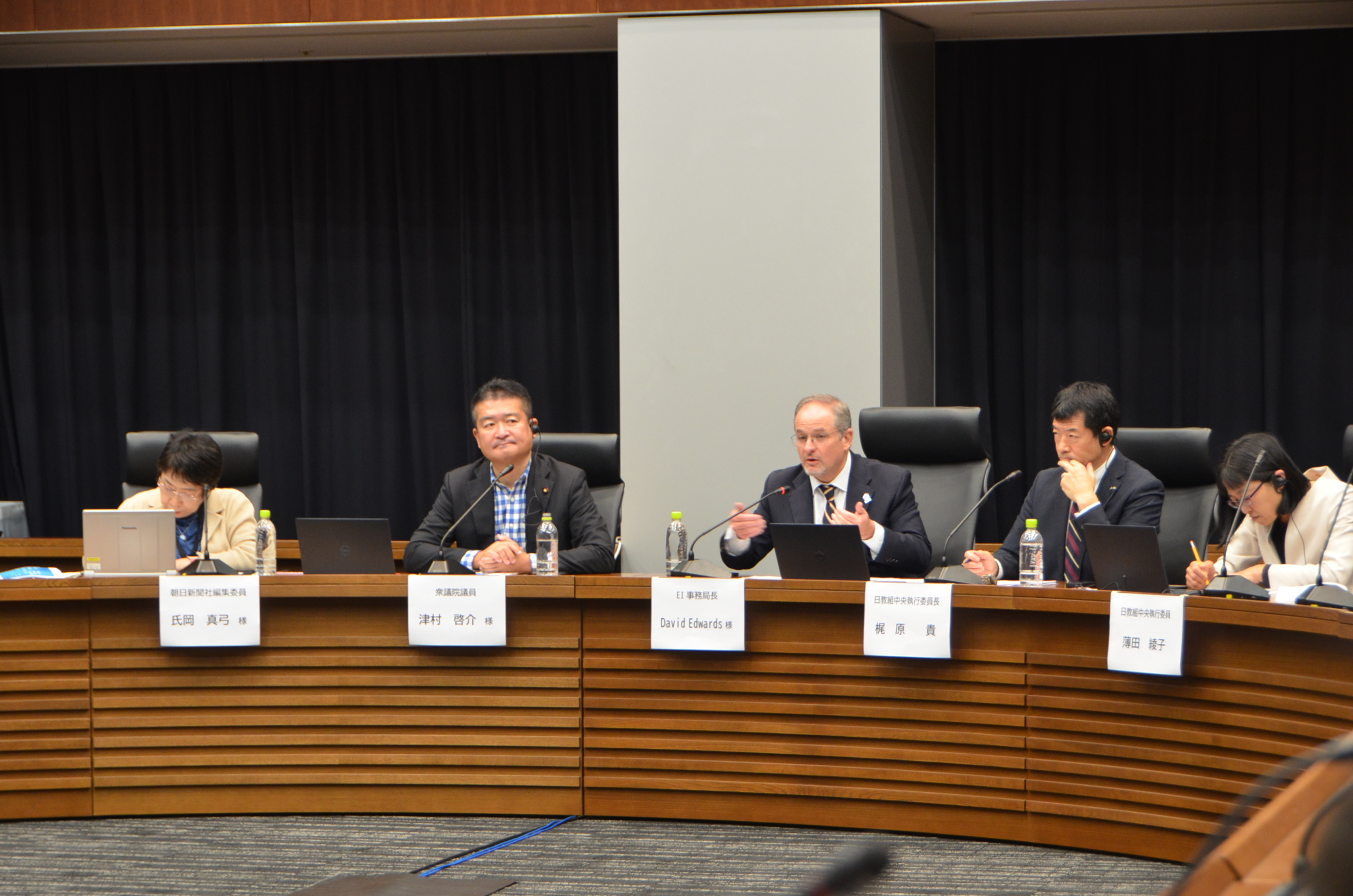
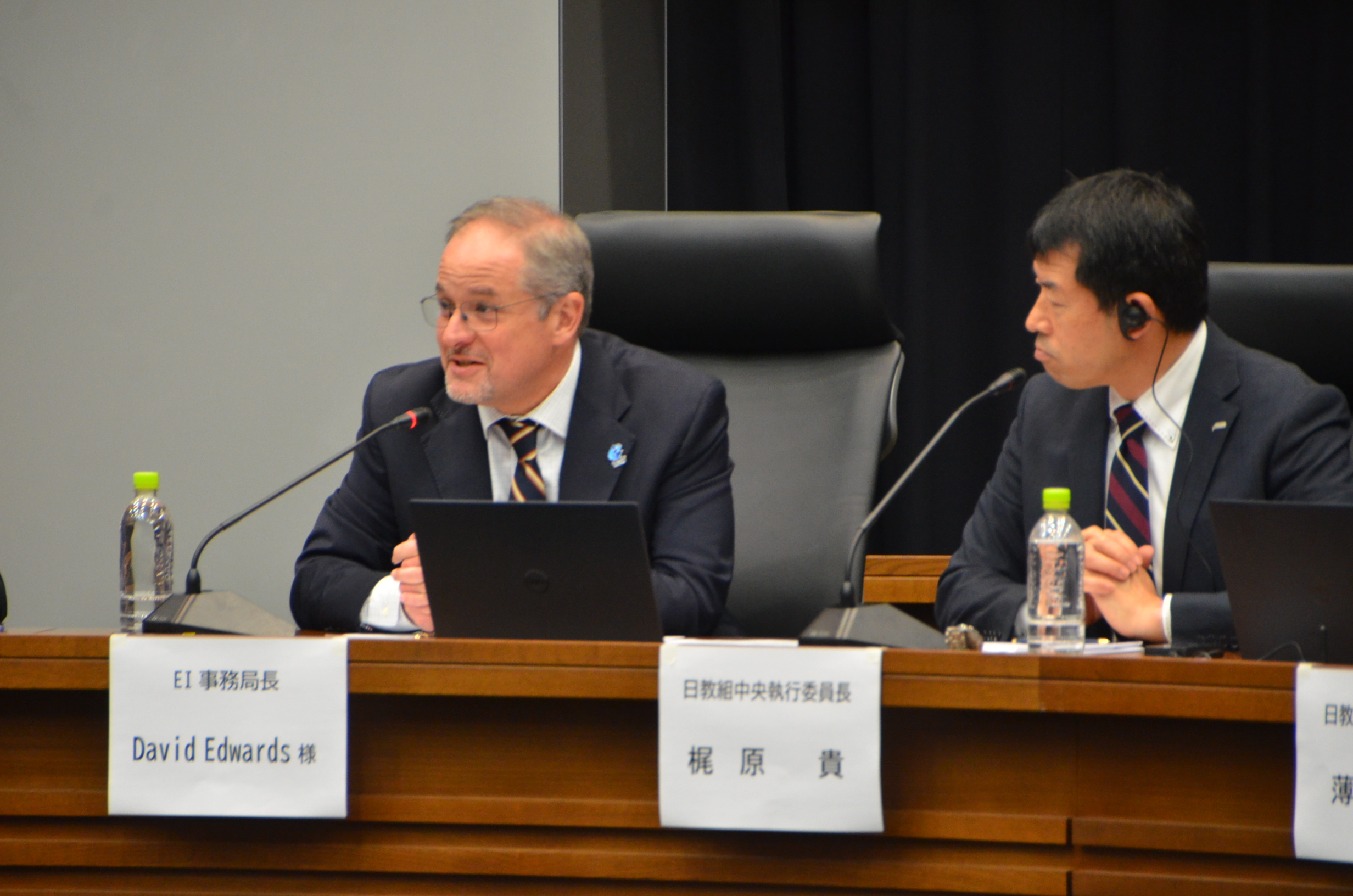
Japan Teachers’ Union (JTU) held on November 7th “Working Style of Educators in Japan Shown by TALIS 2024 Results: How well-being can be achieved to ensure quality learning.” JTU welcomed Dr. David Edwards, General Secretary of Education International (EI), Mr. Keisuke Tsumura, member of the House of Representative, and Ms Mayumi Ujioka, editorial committee member of Asahi Shimbun to analyze and discuss the results of TALIS 2024 by OECD.
At the opening, JTU President Kajiwara stated that the reality revealed by the TALIS survey results—where teachers are overwhelmed by numerous duties, long working hours are the norm, wages are not high relative to workload, and job satisfaction is low—is far from environment where teachers can work to their full potential. He reported that JTU has been working in solidarity with EI and its member organizations to achieve the goals of “reducing workload,” “increasing the number of educators,” and “abolishing or fundamentally revising the Special Measures Law on Public School Teachers’ Salaries.”
David Edwards likened the abnormal working hours of educators in Japan to space, stating that countries like Finland with shorter working hours remain within Earth’s “atmosphere,” while Japan’s work-style reform efforts are still “around Jupiter.” He further stated that policies are needed to bring Japan’s educators back into the “atmosphere,” and that our challenge is to clearly convey the scale and urgency of the problems Japan’s educators face to politicians and the general public.
Mr. Tsumura emphasized that despite the era of cramming knowledge into students having ended, Japan has failed to reform its education system. He stressed that in the future of education, it is essential to increase the education budget to ensure Japan is not left behind in global transformation—through initiatives like utilizing AI alongside reforming the working conditions of educators. He further emphasized that politics must take on the role of driving innovation to support the dynamism of education.
Ms. Ujioka had anticipated that Japan’s teachers work the longest hours, but what surprised her more was that scores for “collegiality”—indicators such as “teachers can trust each other,” “staff share beliefs about teaching and learning,” and “there is cooperative school culture where teachers help each other”—and for “collaboration with colleagues in teaching” had declined since the previous survey. She pointed out that the severity of the crisis in schools may not be properly reaching the authorization and administration.
Many members from affiliated unions across the country participated both in person and online. Through Q&A sessions with in-person attendees, concrete pathways for ensuring educators’ well-being to ensure quality learning were discussed; increasing the number of educators per school; ensuring the implementation of measures included in the supplementary provisions of the Special Measures Law for Public School Teachers’ Salaries; the need for those involved in education to speak up more; and the necessity for educators to have more opportunities to learn about the benefits and drawbacks of AI and similar technologies. In response, Kajiwara emphasized that “social dialogue” is indispensable for solving these issues. He stressed the importance of evidence-based insights, and labor unions, journalists, and legislators advancing efforts from their respective positions based on evidence from researchers.
The TALIS survey results provide crucial evidence. While the teacher shortage is worsening, the urgent realities on the ground often fail to reach administrative bodies. We confirmed that resolving this issue requires us to strengthen collaboration with the media and politicians. The Japan Teachers’ Union reaffirmed its commitment to continue collaborating with educators worldwide and working through social dialogue to achieve sustainable school education and the well-being of both educators and children. The symposium concluded with the sharing of appeal statement.